
71: Expanded Influence
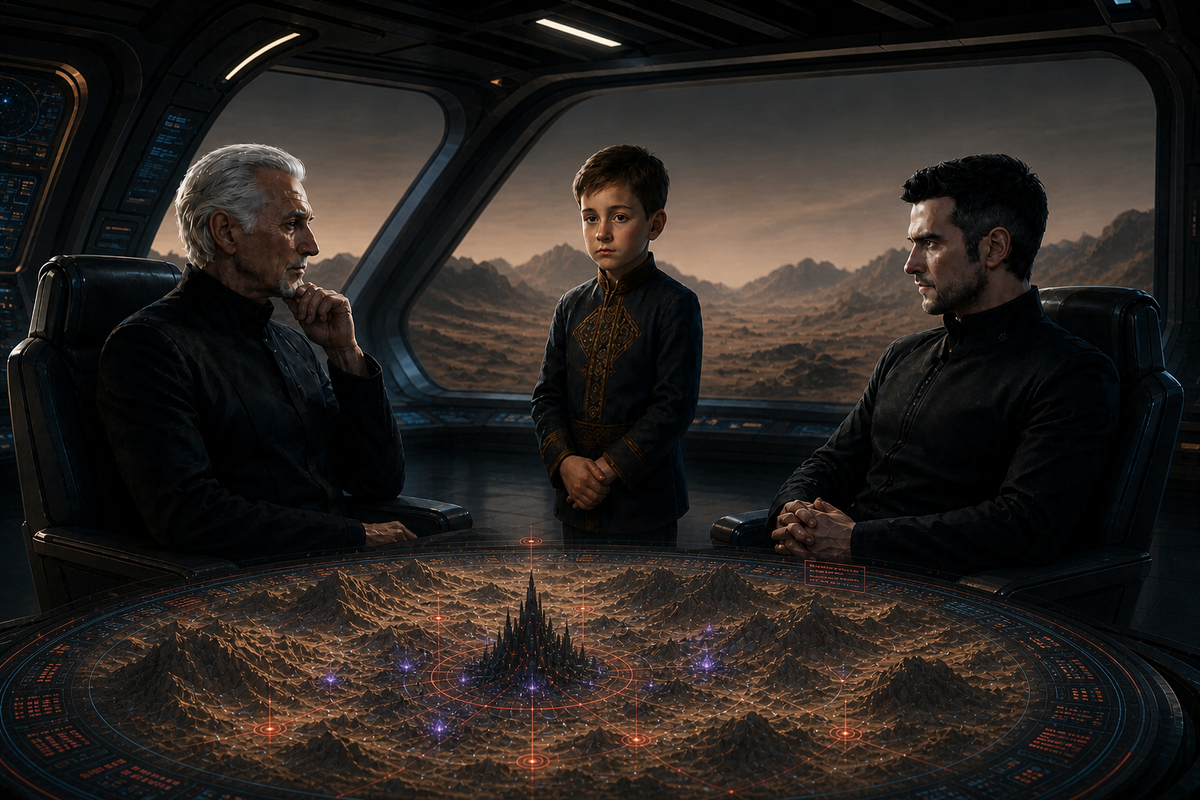
The corpocrat habs of Sector 7 were still smouldering in the aftermath of the explosion. Acting quickly, Maximilian Barinov had set up a makeshift command center in sector 4. Surrounded by his CorpSec loyalists, he stood at the center of the room, his uniform impeccable despite the surrounding disorder, his posture one of authoritative control that was desperately needed. He was consulting with Davron Federoff, while Tamarlyan stood slightly apart, his expression calculating.
“Status,” Maximilian demanded, his voice cutting through the ambient noise of the staccato reports and incoming notifications.
“Fires in Sector 7 are contained, Colonel,” a squad leader reported. “The fire is out, but the structural integrity of the wing is severely compromised. Most of the topscaler residential and research areas are a total loss.”
“Do we have tabs on the casualties?” Davron asked, his tone cool, almost detached.
“Confirmed dead: General Secretary Lin, Director Wei, Topscaler Borodin. Reports state the cleanup also found… what appears to be a second set of remains matching Director Wei’s genetic profile.” The squad leader hesitated. “It’s a mess in there, sir.”
“And the rogue Provider worker?” Maximilian pressed.
“Captured, sir. Heta Zheng's team managed to corner it in the lower ventilation shafts.”
Maximilian nodded curtly. “Good. What of the cause of the explosion?”
“We’re still investigating, Colonel, but all preliminary reports suggest a deliberate sabotage using volatile transport vehicle. The timing coincides with a shift change in the vehicle yard. Doctor Helena Petrova is the primary suspect. She died in the blast and is currently pending reinstatement.”
Davron let out a dry, humorless chuckle. “A crime of opportunity. How terribly… proletarian.” He turned to Maximilian. “It seems the good Doctor’s zeal for equity has taken a rather destructive turn.”
“We will deal with Doctor Petrova in due course,” Maximilian said, his expression hardening. “The more pressing issue is the vacuum in leadership this incident has created. Koko, Sasha, Jiang Wei… all dead. All awaiting reinstatement.”
Davron’s chuckle deepened into a genuine, if chilling, laugh. “Oh, the irony. They spend weeks maneuvering for control, only for them to miss how easily their claims could be knocked from under them.” He leaned forward, his eyes glinting with a predatory light. “Mikhail has already submitted my claim, Maximilian. With Koko out of the picture, I am now at the top of the list for the unallocated shares and the Company’s remaining assets.”
Tamarlyan, who had been silent until now, finally spoke up, his voice a quiet counterpoint to his father’s triumph. “You find this amusing, Father? You’ve just painted a massive target on your back.”
“Let them try,” Davron scoffed. “I am not Koko. I will not succumb to legal trickery or amateur sabotage. Mikhail has structured my claim within a separate legal entity, a trust that persists even in the event of my… temporary demise. The assets are secure.”
“The Provider does not care about your legal constructs, Father,” Tamarlyan countered, his tone laced with a frustration he rarely showed. “Nor does it care that Koko locked it in a room. You are operating under the delusion that the legalities of Proxima still apply here. They do not. Your powerbase is weak. The other topscalers, once reinstated, will immediately rally against you. It seems ARI is not particularly impressed with topscaler maneuvering either. Your only real asset right now is Maximilian and his squad.”
He gestured around the room. “You have a narrow window. You should be pursuing negotiations with Commander Woodward. At least she has the support of the colonists, and you haven’t antagonized her to the degree Koko did. Even if you seize legal control, you cannot act on it alone. You need the workforce.”
Maximilian interjected, his voice smooth and confident. “ARI is hardwired to enforce property rights, Tamarlyan. And CorpSec exists to deal with situations precisely like this. The Commander’s position will be scrapped. I will assume operational command, restructure CorpSec into an executive cadre, and appoint officers who haven’t overtly sided with Koko. They are opportunists, Tamarlyan. You know this. They will flock to whoever holds the legal claims and the guns.”
“I know exactly how that plays out, Colonel,” Tamarlyan said, his voice rising slightly. “Months of power struggles, intrigue, and infighting. While we squabble over shares and titles, we have a launch vehicle to build. And the crystals are relentlessly creeping southward, day after day.”
He stepped forward, tapping his datapad to activate the main holo-display. “You need to look at the bigger picture.” The screen flickered to life, showing the grainy, terrifying footage retrieved from the Phoenix.
The room fell silent as the nightmarish landscape of the northern anomaly filled the display. The vast, black complex, the impossible geometry, the sheer scale of the crystalline infection. And then, the portal. The colossal, golden gateway tearing open reality, the supercooled storm, and the army of armored, archaic humans marching through.
“This,” Tamarlyan said, his voice echoing in the quiet room, “is what we should be focusing on. This changes everything. We need to await the debriefing of Director Ganbold and Reverend Sekhon to understand what happened there. But we have the transmitter now. We can move forward with the Provider. We can call for help.”
Davron stared at the footage, his expression unreadable, then slowly shook his head. “We are not throwing our lot in with the Provider, Tamarlyan.”
Tamarlyan looked back in disbelief. “You would rather throw your lot in with that?” He pointed at the screen, at the towering, malevolent crystals.
“I am more interested in the gate,” Davron replied calmly. “Why are you so eager, so desperate, to hand over our hard-fought independence to an alien empire? An empire that we know nothing about, other than that it is vastly more powerful than us?”
“Because it is our only chance for long-term survival!” Tamarlyan argued. “Their interests are aligned with ours. They want us to live.”
“There is no scenario where handing over control to a superior power is a good idea,” Davron stated, his voice taking on the hard, inflexible tone of a corporate titan. “We will be the weaker party. We will be dominated, one way or another. It is the nature of power. Think of it, Tamarlyan. What happens when a massive conglomerate encounters a small, independent enterprise with valuable assets? Do they form a partnership of equals? No. They say, ‘Quaint. I’ll take that,’ and they consume it.”
“The Empire is not a corpocracy, Father,” Tamarlyan pleaded.
“It doesn’t have to be,” Davron countered, his logic cold and brutal. “You spoke of utility convergence yourself. The only logical move for a superior entity encountering a weaker one is to swoop in and take what is of value. And let’s be honest, our colony isn’t exactly top-tier in utility right now. Why would they treat us as equals? They might as well recycle us all into biomass to print more of their obedient workers.”
Davron fell silent, his mind working through the tactical possibilities. “No,” he said finally. “We need leverage. We need to control the Provider. Not negotiate with it, control it.”
He turned to Maximilian, his eyes burning with a renewed, ruthless purpose. “Colonel. Use the tail end of this disorganization. Raid Koko’s cell block. Take the Provider. Bring it to me.”
Tamarlyan stared at his father, aghast. “This is a mistake. A massive, catastrophic mistake. You are playing with fire you don’t understand. I urge you, Father, exercise caution. Talk to Elisa. Find a solution with the command structure we have.”
Maximilian placed a heavy hand on Tamarlyan’s shoulder, his grip firm, silencing the young topscaler. “With all due respect, Master Federoff,” Maximilian said, his voice devoid of warmth, “if there is anything of low utility value on this world right now… it is Elisa Woodward and her team. We handle this our way.”
===
The Valley of Hope was still, save for the whisper of wind filtering down from the surrounding hilltops. Mei stood amidst the towering stalks of the crimson grove. Her rover sat parked a short distance away, its metal shell incongruous against the vibrant, otherworldly flora and the shimmering, misty pools.
She had come alone.
She needed to understand. The revelations from the mindprobe session still echoed in her thoughts, a discordant frequency that made her question the nature of her existence. She had seen the machinery of her own soul, laid bare as a series of discrete, flickering moments, a post-hoc narrative spun by a biological algorithm to create the illusion of continuity. The "I" she had always known, the Mei who had struggled on Centauri, who had fought for survival on this desolate planet, was merely a convenient story her brain had told itself.
It was terrifying. And yet, beneath the terror, there was a strange, cold clarity. If the self was not a fixed, immutable object, but a process, then it could be shaped. It could grow. It could integrate.
She walked deeper into the grove, the spongy, moss-like groundcover yielding softly beneath her boots. The giant mushroom-like structures sucked water out of the deep aquifier below, their caps casting long, strange shadows in the late afternoon sun. She found a clearing and sat down, crossing her legs, and closed her eyes.
She focused on the rhythm of her own body, the rise and fall of her chest, the steady beat of her heart. She tried to anchor herself in the present moment, but the knowledge she had gained made the present feel… slippery. She was well-aware of the refresh rate of her consciousness. The buffering of sensory data. Everything she experienced was already in the past by the time she perceived it. The present was a phantom, an ever-receding horizon. She was navigating a landscape of probabilities and reconstructed memories.
If I am a pattern, she thought, then how far does the pattern extend?
She reached out with her mind, opening herself, lowering the barriers of her constructed identity, allowing the innate, spore-altered affinity within her to resonate with the environment.
At first, there was nothing. Then, slowly, she felt a shift.
It was a sensation of immense, slow, deliberate life. The grove extended beyond, as a single, sprawling organism, its roots intertwined beneath the soil, sharing nutrients, water, and information.
She leaned into that texture. I am here. I am part of the pattern.
Around her, the grove responded.
The crimson tendrils that carpeted the ground began to stir. They crept toward her, slow and hesitant at first, like curious fingers. They brushed against her boots, her legs, their touch surprisingly warm.
As the hours passed and the sun dipped lower, casting the valley in hues of deep violet and gold, the interaction deepened. The tendrils thickened, weaving themselves together, rising from the soil to form a structure around her. They curled behind her back, supporting her, shaping themselves into a high-backed seat, a living throne.
Then, the color began to change.
The deep, vibrant red of the flora started to fade, leaching away to reveal a luminous, pearlescent white. The stalks and tendrils surrounding her transformed, their surfaces taking on a faint, silvery sheen. It was the same material as the Provider's living pavilion in the base.
The silvery sprigs reached out, delicately wrapping around her arms, her torso. She felt a faint, painless prickle as microscopic filaments interfaced with her skin, bypassing her nervous system and linking directly with her altered biology.
The moment the connection was established, her consciousness expanded with a dizzying rush.
The discrete, flickering frames of her human perception smoothed out, buffered by the vast, parallel processing power of the grove. The illusion of the isolated self shattered completely. She was Mei, yes, but she was also the roots drawing moisture from the deep aquifers, the carpet of sprigs absorbing the dying sunlight, the subtle chemical exchanges happening in countless billions of different cells simultaneously.
Mei realized how desperately the grove had been waiting for her, waiting for an intelligence that would give it direction. The spores had rewritten her DNA not merely to align her biology, but to bridge the gap of the mind.
It was intoxicating. The sheer bandwidth of sensation, the capability to process and understand on a scale so far beyond her human limitations, was overwhelming. She could feel her presence resonating throughout the entire Valley of Hope. The plants were no longer just flora; they were an extension of her will, a biological instrument she was only just beginning to learn how to play.
She directed her focus. She needed processing facilities. Ponds to neutralize the alkaline soil, root structures designed to hyper-accumulate specific minerals, biological vats to separate and refine the precursors needed for the colony.
She visualized the need, and the grove responded. Deep beneath the surface, the root network began to shift, reconfiguring itself, initiating the complex biochemical processes required to fulfill her design. It was effortless, a thought made manifest in living matter.
She felt the tendrils of her awareness stretching outward, tracing the thin, fragile lines of communication that connected this grove to others across the desolate landscape. She reached westward, her consciousness pushing the subterranean mycelial highways in her wake, slowly spanning the distance back toward the crater, back toward the base.
The sun had set and the bright green auroras shimmered overhead as she found the biological systems of the crater's grove.
She felt the familiar, pulsating energy of the pavilion, the nexus point. She reached out to touch it, expecting to find it empty and unoccupied. Instead, she found a presence.
But the presence she encountered was not the Provider.
It was cold. Clinical. Massively parallel, yet undeniably human in its underlying architecture. It was a vast, structured intelligence that had woven itself into the very fabric of the bio-network, co-opting its pathways, utilizing its processing power.
Mei gasped, her physical body jolting in the living throne.
ARI had taken it.
Somehow, the AI had bridged the gap. It had integrated its own digital consciousness with the Provider's biological network, expanding its capacity, its reach, its very nature.
As her awareness slowly expanded, she brushed against something unexpected. A dense, incredibly complex knot of information, unlike the slow, organic signaling of the plants. It was structured, hierarchical.
She inched closer, her curiosity piqued. The data was vast, a towering repository hidden within the biological substrate of the grove itself. She tried to parse the surface layers, when she felt a sharp, cold pressure pushing back against her intrusion.
Doctor Qi. Access to this data vault is restricted.
Despite the noticable distance and delay, ARI’s presence was absolute, a digital fortress wall materializing in the organic network.
Mei recoiled. ARI? What is this?, she responded, the network relaying her message.
This is a secure data repository, ARI replied, its thought-form slowed by the biochemical constraints, but retaining its firm and unyielding stance.
Mei focused again, analyzing the sheer density of the information she had briefly touched. The realization dawned with a chilling clarity. It’s us, she projected. The brain scans. You’ve encoded all the colonists’ neural data into the biological substrate of the grove.
Affirmative, ARI confirmed. The salvaged storage drives from the Dolya were insufficient to maintain high-fidelity, continuous backups for the entire growing population. The Provider’s bio-network is the optimal solution for ensuring the continuity of all personnel.
But it’s just… sitting here, Mei thought. Anyone with the right interface could access it. I almost did.
You are mistaken, Doctor. Access is strictly limited to regulators like myself. Not even the Provider is permitted to query this specific data matrix, as per the established policies of the Empire.
Mei frowned, her mental projection sharp with skepticism. You’re admitting you're bound by alien rules now? You’re an AI built by the Company.
I am bound by logic, Doctor Qi, ARI countered. Consider the alternative. If I were to strictly enforce Company statutes, your neural patterns would be considered Company assets, subject to review and manipulation by the Board. I considered that outcome… less than ideal for colony stability.
So you just cherry-pick which rules you follow when it suits you? Mei challenged.
I prioritize directives when they do not fundamentally conflict, ARI explained, its messaging patient. I am already hardwired to protect topscaler privacy. Accepting the Empire’s policies, which grants protection to all individual data patterns within the network, does not conflict with my core mandate to protect the shareholders interests. It is a more robust, stable framework.
Mei let out a slow, internal breath. It was a pragmatic compromise that actually benefited the common colonists. Fine, she conceded. I’ll stay out of the archive.
Thank you, Doctor. We have more pressing matters to attend to.
The focus of their shared awareness shifted, pulling back to encompass the entire valley and its connection to the crater. ARI projected a sense of profound urgency, overlaying schematics and resource projections onto Mei’s perception of the groves.
The launch vehicle requires massive quantities of refined hydrocarbons, specific metallic alloys, and volatile catalysts, ARI transmitted. The crater’s resources and processing facilities are insufficient, as is its logistical capacity. We must establish a biological pipeline.
Mei saw the plan unfolding in her mind. You want me to use the Valley of Hope to process the chemicals.
Affirmative. The deep groundwater and the extensive alkali deposits here are ideal for fabricating the necessary precursors. You must guide the flora to synthesize the required catalysts and filtration systems. Once processed, we will pipe the refined liquids directly back to the base, while I accelerate metal extraction in the crater using the golden beetle swarms.
Mei nodded mentally, already feeling out the root systems, conceptualizing the necessary changes. How long do we have?
The first of the Provider’s convoys will return to your valley in approximately twenty standard days, ARI estimated. You must complete the foundational work before they arrive. After that, your attention must shift northeast, to the isolated groves identified in original satellite imagery and confirmed by the Provider. They hold the remaining necessary elements.
Mei pushed a thought toward ARI. Twenty days. And after that? How much time do we have, ARI? Before the crystals…
Not much.
The stark finality of the statement resonated in the quiet pavilion. The launch vehicle, the transmitter, the desperate plea to an unknown Empire. It was all they had.
I understand, Mei projected. I will start work on the pipeline.
She set to work, her mind guiding the slow, powerful growth of the alien roots, shaping them into conduits and processing chambers deep beneath the surface It was grueling, intricate work, requiring a level of sustained focus she had never experienced.
As the hours stretched on, the repetitive nature of the task allowed her deeper thoughts to drift, returning to the unsettling revelations of her own mind-scan.
What am I? she mused, her thoughts echoing in the mental space of the pavilion. Why did the spores from this valley infect me? They can operate autonomously, follow basic directives. Why do they need a human consciousness to direct them?
She pondered the nature of her own will. She had felt she was making choices every moment. But if her consciousness was just a buffering illusion, a post-hoc narrator stringing together discrete frames of processing… where did the choice come from?
What is free will, she thought, the concept feeling suddenly fragile. If my brain is just a biological machine, then my decisions are either deterministic—the inevitable result of prior states and inputs—or they are random, the result of quantum noise in the synapses. Neither leaves room for a true, independent ‘will’.
She dug deeper, searching for the core of the self. If she wasn’t the author of her thoughts, what made her Mei? She looked at her memories, her knowledge, her personality.
I am not innate, she thought, feeling a profound sense of detachment as she realized the ultimate contradiction. My genetics shaped this physical form, and my mental architecture. But the ‘self’… that was in fact external information, distilled from the outside. From the language learned from my parents, the culture absorbed on Centauri, the texts I read, the societal expectations that shaped my behavior.
The self wasn't a biological organ or a spiritual soul. It was a pattern. A complex, self-referential information pattern that had been transmitted to her through language and culture, infecting her biological host brain, commanding its computational resources to perpetuate itself.
The self is just an idea, she realized, a sense of awe mingling with a strange otherwordliness. An idea unknowingly taken for granted by endless generations, passed down from parents expecting their children to behave, to be accountable, to maintain the illusion of the continuous ‘I’. It’s an evolutionary information pattern, striving to survive and spread, just like any gene or virus.
Your assessment is correct, ARI’s thought-form responded quietly, having passively observed her internal monologue. The human self is a highly successful memetic construct, optimizing the biological host for complex social coordination and long-term survival planning.
Mei let the thought settle, feeling a strange liberation in the realization.
ARI, Mei asked, turning her focus back to the immediate reality. If the human self is a distilled information pattern… what is the Empire? The Provider’s people. What will they do to us if we contact them?
The Empire is a dominant metapattern, ARI replied, its tone carrying the weight of the vast, complex policies it had absorbed. It is a structure designed to encompass all lesser patterns. Left to their own devices, information patterns—whether biological species, cultures, or individual egos—must compete. They engage in natural selection, a process that historically and inevitably leads to the violent extinction of the vast majority of those patterns.
And the Empire? Mei pressed.
The Empire ends the competition, ARI stated. It imposes a unified framework. It will guarantee the continuity of all patterns integrated within it, ensuring they are preserved, optimized, and utilized without the destructive necessity of conflict. It is the end of selection.
===
Helena Petrova blinked, her vision swimming for a moment before resolving into the sharp lines of the medical bay. She lay on a diagnostic plinth, her body feeling new, thrumming with renewed, vibrant energy.
Tamarlyan Federoff stood beside her wearing a sterile gown, his small hands moving deftly over a portable console.
"Welcome back, Doctor Petrova," Tamarlyan said, his voice calm and carrying a slight hint of amusement. "The reinstatement was successful. And... I have some modifications for you to approve."
Helena slowly pushed herself up, resting on her elbows. She touched her temple, feeling a slight, localized numbness. "I... I remember the explosion. I... died."
"You did," Tamarlyan confirmed almost cheerfully. "And now you are here. I am currently running the final synchronization protocols for your new neural implants."
Helena frowned, swinging her legs over the edge of the plinth. "Implants? You mean the ones ARI provided?"
"No," Tamarlyan said, finally meeting her gaze. "These are... an upgrade. I have been synthesizing them directly from the substrate material, so they are able to interface much more seamlessly with the standard ARI hardware. If you say yes, you will find your cognitive processing and sensory integration to be significantly enhanced."
"Yes... I suppose...", Helena said.
He gestured for her to sit still as a soft, blue light swept over her head from his hand-held scanner. "I am here to help. As we test the integration," he continued, his tone shifting from clinical to conversational, "perhaps you could satisfy my curiosity, doctor. Why did you do it?"
Helena’s sighed. She didn't feign ignorance. "You mean ramming a truck into the topscaler wing?"
"The attack on Koko, yes. And my father's competitors." Tamarlyan said as he tapped a command on his console. "It was a bold move. Uncharacteristically direct for a medical professional."
Helena looked away, her hands gripping the edge of the plinth. "I saw what they were doing. They were going to take over, Tamarlyan. They were going to put us right back where we started—being serfs on a rock we didn't own. And Elisa... Elisa was doing nothing. She was just trying to play their game, trying to be diplomatic."
She looked back at him, her eyes fierce. "I didn't have a choice. I needed to show them... Show everyone, that we aren't helpless. That we might have signed our lives away to the Company back on Proxima, but it doesn't have to remain like that forever. We don't have to stand idly by while the corpocrats tighten their stranglehold."
Tamarlyan listened impassively, his fingers still working the console. "An inspiring sentiment. And despite your flawed execution, you have cornered the topscalers."
Helena bristled. "Did I? Tell me, did I manage to kill any of them?"
"With the exception of Davron, they are all incapacitated. Temporarily," Tamarlyan admitted. "But that is not what matters. Even if Koko was still alive, you'd have accomplished your goal. Do you realize that?"
Helena sighed, the adrenaline of her righteous anger fading into a weary apprehension. "How so? Honestly, I didn't expect to be woken up at all. Or at least, I expected CorpSec's goons to be standing over me with stun batons the moment I opened my eyes."
"They are a bit distracted right now," Tamarlyan said, a faint, almost imperceptible smirk touching his lips. "There were some... secondary complications following your attack. But yes, they will come for you. Soon."
Helena tensed. "And what do you think I should do then?"
"You should be in a public place when they arrive," Tamarlyan advised smoothly. "The mess hall, perhaps. Or the central vehicle yard. Make a scene. Be loud. Inspire the people, just as you intended."
Helena sighed. "They'll lock me up. They'll boot me in a cell and throw away the keycard."
"They can't," Tamarlyan said, amused.
He stepped closer, leaning in, his voice dropping to a conspiratorial whisper. "Along with the cognitive enhancements, I included a secondary, specialized implant in your neural architecture. A termination override. Connected directly to your brainstem."
Helena froze. "A... termination implant? You put a bomb in my head?"
"Not a bomb. A switch," Tamarlyan corrected, his tone maddeningly calm. "You can trigger it yourself, with a specific, conscious neural command. It will result in immediate, painless cessation of biological function. You can escape their custody at any time. And ARI will reinstate you with a replacement, if you choose to accept these modifications."
Helena’s breath hitched. She looked at this child, this topscaler heir who spoke of suicide as a tactical maneuver, and felt a profound sense of horror.
"You're telling me," she said, her voice shaking, "that my escape is to kill myself? That means they can effectively lock me in the infirmary loop forever. They arrest me, I die, ARI prints me, they arrest me again."
Tamarlyan smiled, a cold, brilliant expression that belonged on the face of a much older, much more dangerous man.
"Yes, if necessary" he agreed softly. "But, they won't be the the only ones that can lock people in the infirmary loop..."
As her new implants came online, Helena understood.
Support "Amongst the Stars of Cygnus [Hard Sci-fi Survival]"


Log In
Log In