

65: The Local Maximum
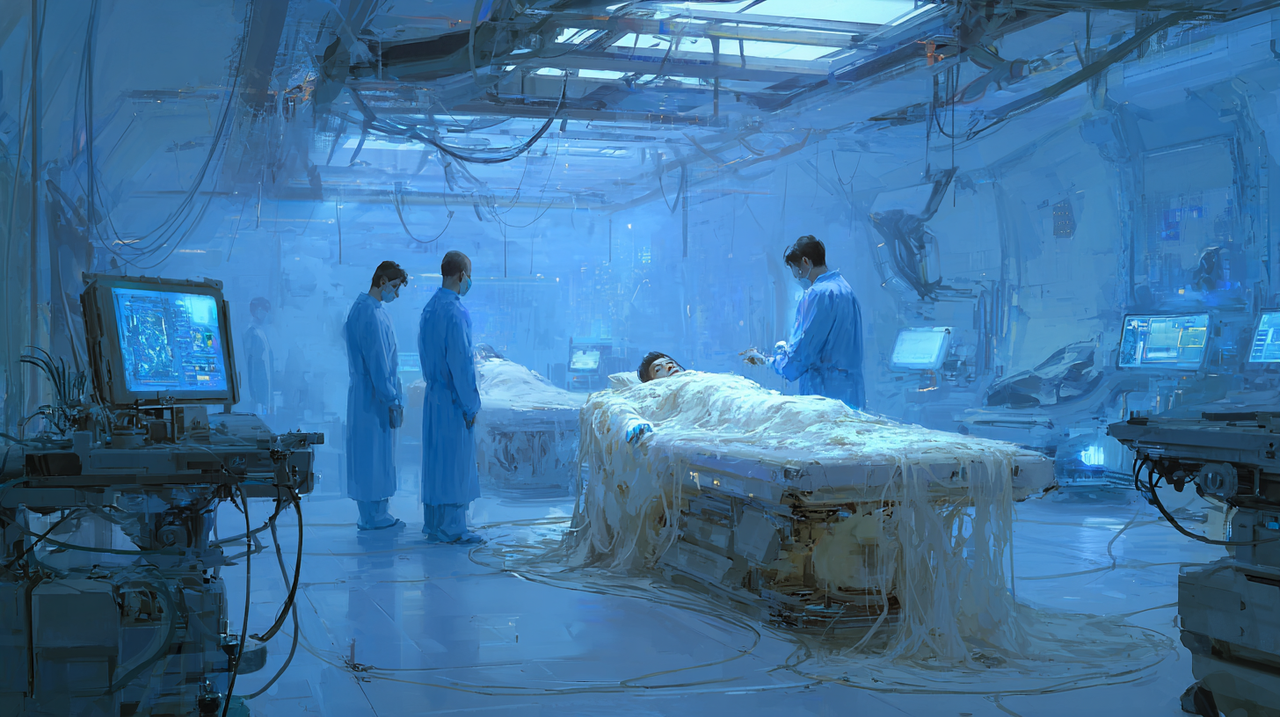
The sterile white walls of the topscaler research lab reflected the harsh, unforgiving light of the diagnostic panels. Doctor Bao Vang paced in front of two motionless figures, his hands clasped tightly behind his back, a vein throbbing in his temple. The figures, both grown from the Provider’s substrate in a matter of days, were perfect physical specimens of middle-aged Taihezu men—strong, healthy, and utterly, maddeningly, unresponsive. They stood with a slack-jawed vacancy, their eyes open but seeing nothing.
“Report,” Vang snapped at one of his subordinate scientists, a young, anxious man named Chen.
Chen flinched, tapping nervously at his datapad. “The neural imprinting was successful in vitro, Doctor. The instruction set for basic motor functions and language comprehension was transcribed without error. We’ve tested it as code. I… I don’t understand why it’s not functioning in vivo. The instruction set, the loyalty protocols, they functioned perfectly in every simulation. The code is clean. Either the transcription to the genetic medium was flawed during the growth cycle, or… or there’s a variable we haven’t accounted for.”
In the corner of the lab, two of Wei's private security detail stood ready, their black visors reflecting the scene. They were silent, but their presence was a constant, oppressive reminder that every failure was being noted, logged, and would be reported back to Jiang Wei and the others.
“Use your implants,” Vang ordered, his voice tight with controlled anger. “Push the update again. Direct neural interface. Force the initialization.”
The subordinate nodded, the output of his own cybernetic implants projected across the screen in front of him as he focused. On the plinth, one of the new workers twitched, its limbs spasming for a moment, but then it fell still again, its gaze as empty as before.
“Useless,” Vang hissed, turning away in disgust, just about to unleash a fresh tirade of anger when the lab door slid open.
Jiang Wei entered, followed by Koko, her presence instantly commanding the room’s attention. Vang’s entire demeanor shifted in a heartbeat. The frustrated, volatile scientist vanished, replaced by a man radiating confidence and success.
One of Vang’s underlings, seeing the newcomers without protective gear, instinctively stepped forward. “Directors, I must insist you wear proper sterile—”
“Silence,” Vang cut him off, his glare so withering that the young man physically recoiled, stammering an apology before retreating to the far side of the lab.
“Director Wei, General Secretary Lin,” Vang said, turning to them with a brilliant, sycophantic smile. “Welcome! As you can see, your project is proceeding exceptionally well.” He gestured proudly to the two inert figures. “We have successfully printed our first two proprietary units. Perfect human likeness, as you can see. Peak physical condition.”
Koko stepped closer, her sharp eyes appraising the worker’s handsome, well-defined features. “They are… aesthetically pleasing, Doctor Vang,” she conceded, a rare compliment that made Vang positively beam.
“And how long until we can expect our first shipment?” Jiang Wei asked, getting straight to the point.
“We are currently running the final diagnostic tests, Director,” Vang replied smoothly, projecting an air of meticulous caution. “Everything looks excellent, but I want to make some minor adjustments to the cognitive matrix to ensure optimal performance. A few more days... General Secretary Lin will have her first batch of household staff very soon.”
“Excellent,” Jiang Wei said, clearly pleased.
Their self-congratulatory moment was interrupted by the lab door sliding open again. Mei and Helena stood at the threshold, clad in full sterile environmental suits, their expressions grim. Before they could step further, the two guards moved to block their path.
“What is the meaning of this?” Mei demanded, her voice sharp. She looked past the guards at Jiang Wei. “Director, I have logged multiple unauthorized requisitions of reinstatement substrate and vital organic compounds from the medical facility. They were traced here.”
Jiang Wei’s pleasant smile didn’t waver. “Those materials are not your property to grant or deny permission for, Doctor Qi. They are assets of the Company, and by extension, its primary shareholders. I, as a director of this initiative, approved their reallocation for this priority project.”
“What project?” Mei shot back.
“That,” Jiang Wei said coolly, “is not your concern.”
“Anything involving reinstatement technology and the use of medical-grade substrate is absolutely my concern,” Mei retorted. “I am the Chief Medical Officer of this colony.”
Koko stepped forward, her voice cutting through the tension like a shard of ice. “You are the Chief Medical Officer, Doctor Qi, by the grace of the shareholders who created and funded that position. Should you wish to retain that position in the future, you might wish to consider aligning your behavior with the interests of the majority shareholder.” Her gaze was utterly devoid of warmth. “Namely, mine.”
“This is bullshit,” Helena interjected, her language drawing an immediate reaction of surprise and discomfort from the assembled group of scientists. “While you’re in here sequestering resources, the rest of the colony is trying to deal with the encroaching crystal anomaly and gathering the materials we need for the launch vehicle. Even Director Federoff is contributing designs for the vessel. Why are you and Director Wei running rogue projects instead of involving everyone?” When she was met with only cold silence, she pressed on. “Commander Woodward has mandated that all personnel contribute to the colony. And I have some tasks in mind for you that are far more constructive than this...”
Koko let out a soft, almost inaudible sigh, as if dealing with a particularly tiresome child. She excused herself from Jiang Wei and glided back into the corridor. Helena and Mei followed, while Koko's household guards and entourage of attendants were trailing behind at a respectful distance.
Koko stopped and turned with a sudden move, her posture a masterpiece of meticulous self-control. Her hair was perfectly coiffed, her hands folded gracefully before her, her long nails a stark, elegant statement. Helena's impassioned words had failed to leave a mark on her expression.
“Let us be perfectly clear, Doctor Petrova,” Koko began, her voice a silken, condescending murmur. “I will soon be making the decisions here, not Commander Woodward. I set the tasks and the goals, not you. I, and those like me, are the only ones with the vision and the experience to ensure the long-term survival and prosperity of this venture. We built the Centauran worlds, we lifted Earth from its deplorable state, we had the foresight to invest in this very expedition. We always know best.”
“It was the labor of millions that built all of that,” Helena argued fiercely.
Koko dismissed the notion with a wave of her hand. “It was topscaler investment that allow the low and midscale laborers to exist in the first place. Their sole purpose, their entire reason for being, is to repay that investment. They would have no economy, no civilization, no human workers, no colonies at all, if not for the capital investment that made it so. I am frankly astonished that you and Doctor Qi, instead of showing gratitude for the opportunities you have been given, continue to pursue your own unaligned, selfish interests. That, in itself, constitites a form of theft. It is this fundamental misunderstanding, this moral deficiency that is the reason the efforts of the lower scales never amount to anything.”
Mei, who had been silent until now, finally spoke. “Proxima was built on meritocracy, not just topscaler credit. That is what allowed it to thrive.”
A genuine, dismissive smirk touched Koko’s lips. “Oh, my dear Doctor... I don't even know where to begin. The Centauran Conglomerate’s executive committee sets the criteria for what constitutes ‘merit’ every kilocycle. Those criteria are… flexible. They are adjusted to meet the Conglomerate's shifting needs, more importantly, to maximize profitability. Merit is a measure for the expected return on our investment.”
Mei was stunned. “Pardon me but... Are you saying eugenics program, the selection tests… weren’t based on objective ability?”
Koko looked at her as if she were explaining something to a very slow child. “But no, the ultimate weighting is always towards what output will generate the most profit per credit invested. We constructed the population to suit our needs. If you passed one of our genetic selections, Doctor, it is simply because your genetic profile matched our needs for the next generation of labourers. This is how we build lasting civilizations. This is why I urge you to behave and fall in line. Your continued survival quite frankly depends on it.”
Mei didn’t reveal that she had failed. She couldn’t, especially not in front of this woman. Instead, she simply nodded, a profound, hollow ache spreading through her chest. “Thank you, General Secretary,” she said, her voice a near-whisper. “For the… insight. If you'll excuse me, I'll make my considerations.” She nodded and turned and walked away.
Helena shot Koko one last look of pure, unadulterated hostility before hurrying after Mei.
She caught up to her in a quiet side corridor, out of sight. Mei was leaning against the wall, her head in her hands, her body shaking with silent, wracking sobs.
“Mei?” Helena said gently, putting a hand on her shoulder.
Mei choked out, her voice muffled. “So, in he end, was never about being the best. It was just about my potential offspring being… profitable. I wasn’t good enough. Not even for that.”
Helena, who had once aced her own selection exams and had always believed in her own hard-won merit, felt a surge of empathy. She pulled Mei into a firm, comforting embrace. “No,” she said, her voice fierce. “You’re not just an asset on a spreadsheet, Mei. You’re holding together this colony. You’re a survivor. You’re my friend. And that’s worth more than all of their damn investments.”
===
The moment the lab door hissed shut behind Jiang Wei, the mask of fawning deference dropped from Bao Vang’s face. He turned on his team, who were still clustered nervously by the main console, his voice a low, dangerous hiss.
“Idiots,” he spat. “Incompetent, worthless idiots. Do you have any idea how close you came to ruining everything? You are supposed to be the best minds the Wei Consortium could procure, and you can’t even activate a simple biological asset.”
His subordinate scientist flinched. “Doctor Vang, we’ve run every diagnostic. The genetic transcription is perfect. The neural pathways are fully formed. There is no logical reason for their non-responsiveness.”
“Then find one!” Vang roared, his composure shattering. “Or I will find a reason to have you all reassigned to atmospheric scrubber maintenance. Permanently.” He paced in front of them, his mind racing, the pressure of Jiang Wei’s expectations a physical weight on his shoulders. He needed results, and soon.
He stopped, running a hand over his face, forcing himself to regain control. “Alright,” he said, his voice returning to its cold, clipped tone. “Everyone out. I’ll be working late. Again. I will fix this this myself.”
His team practically fled the room, relieved to escape his wrath. Once the guards were gone, Vang strode to the main console and, one by one, shut down every active system. He walked the perimeter of the lab, scanner in hand, searching for the telltale glint of an optical sensor, his device sweeping for any surveillance signals. Finding nothing, he seemed to relax slightly.
He walked past the two inert, newly-printed workers on their plinths, his expression one of pure contempt. His path led him to a quieter, darker corner of the lab, where a row of empty cryo-stasis pods stood, repurposed for storage. He stopped before one that was deliberately marked with a diagnostic error tag, its viewport cracked and opaque.
He keyed in a sequence on the pod’s control panel. With a soft hiss of depressurization, the door slid open, revealing not a sleeping colonist, but one of the Provider’s original workers, curled in a sedated, dormant state.
He retrieved a hypo-injector from a nearby medical kit and administered a dose of stimulant into the worker’s neck. “Wake up,” he commanded, his voice a low, urgent growl.
The worker’s dark eyes flashed open. It sat up, its movements fluid and immediate, showing no signs of grogginess or disorientation. It looked at Vang, its pale, cybernetically-etched face expressing serene readiness. “Ser. How may I be of assistance?”
Vang didn’t waste time with pleasantries. He gestured sharply towards the two failed replicas on the plinths. “I have transcribed the loyalty and activation protocols as per our previous sessions. But the units remain non-functional. I have implemented the hidden layer to the loyalty protocol, binding the units to me on keyword activation. The code is logically sound. It simulates perfectly. But it fails to initialize in vivo. Why?”
He pushed his datapad into the worker’s hands, the screen already displaying dense blocks of his modified code. The worker took the pad, its dark eyes scanning the information with an inhuman speed. It did not question Vang’s actions. It did not ask why he was attempting to subvert its own kind’s loyalty. It had been given a problem to solve, an instruction to follow, and it obeyed.
The worker tilted its head, its dark eyes seeming to process the query with an inhuman speed. “The modifications you have implemented to the core loyalty matrix have created a conflict within the units' directive processing module, ser. The new units are instructed to have an initial loyalty to ‘The Directorate,’ but their foundational programming—”
“Then fix it!” Vang ordered. “Show me how to recompile the loyalty matrix. I need a functional workaround. Now.”
Without a word, the Provider’s worker began to work. Its long, slender fingers danced across the datapad’s interface, lines of complex code and alien genetic notation scrolling by at a dizzying speed.
Bao Vang stood back, watching, a grim, triumphant smile finally touching his lips.
===
Tamarlyan’s quarters were spartan, a deliberate choice that stood in stark contrast to the opulent suite his father now occupied. Davron Federoff entered, two of his own household guards posted outside the door. Yao Guowei, Tamarlyan noted with a flicker of internal amusement, had been firmly kept away.
“Father,” Tamarlyan greeted, rising from his seat. “It took you a long time to visit.”
“I have been busy,” Davron replied, his gaze sweeping the room, taking in its lack of luxury or personal effects, its monastic simplicity.
“Yes, I’ve seen,” Tamarlyan said, genuine approval sounding through in his voice. “You have been assisting with the launch vehicle designs. It is good that you are contributing. Seeking contact with the Provider’s Empire is our only viable long-term strategy. And the short-term one as well, considering the spread rates of the crystals.”
Davron’s expression remained skeptical. “I am glad to be working on the launch vehicle, yes. But not to call for outside help. I am taking the first step toward self-sufficiency. Resources can be mined from the moons, from asteroids. Solar energy can be beamed down to the surface, bypassing this planet’s inherent bottlenecks. We will solve our problems the way humanity always has, Tamarlyan, by engineering our way out of them, not by begging for help.”
Tamarlyan sighed. “You are underestimating the threat, Father. The crystals are not a simple environmental hazard. They are a competing ecosystem, and they are spreading southward from the northern anomaly.”
“And we will engineer our way out of that problem as well,” Davron stated. “I cannot, and will not, allow the Provider to take over this colony.”
Tamarlyan finally asked the question that had been lingering between them. “Why are you, and by extension the other topscalers, so profoundly skeptical of the Provider? I am convinced its motives are legitimate. Its goals are aligned with our own survival.”
Davron’s composure finally cracked. “Why are you so naive?” he snapped. “So eager to hand over our agency, our very future, to an alien entity? Even if its interests are ‘aligned,’ it is exponentially more powerful. It will force its own systems upon us, because it must. Look at what happened to Doctor Qi. The Provider’s genetic architecture has replaced her human baseline, just like that. You can argue that it works, that she is healthier, that it is not malignant. But that is irrelevant. More than half the colony, including me, are now running on the Provider's bioengineering architecture. We have tossed out our independence and become a subordinate client. It is something they control, something they can potentially take away or turn against us at any time. A simple, fundamental question, Tamarlyan: how are we to reproduce now? Human and ‘Provider-human’ DNA are not be compatible. So what is our future? Do we breed a segregated population of ‘unadulterated’ humans? Or do we become entirely dependent on their substrate to grow our children?”
“The Provider-human hybrids are superior,” Tamarlyan countered calmly. “Mei, Otto, the others—they are healthier, they heal faster, which gives a distinct advantage in this world’s high-oxygen atmosphere. They can be easily fitted with the new generation of neural implants I am developing. They can be reinstated. Why would you want to roll back to the vulnerabilities of the baseline human form? Why discard these improvements?”
“Because it will not end there!” Davron’s voice was a low, intense growl. “Because we do not control it. We are on a trajectory of complete and utter dependence. It is in the very name, Tamarlyan: the Provider. It provides. And the one who provides is the one who controls. It will take away our agency.”
“That is a fallacy,” Tamarlyan said, his tone shifting from respectful debate to clinical analysis. “The available action space under the Provider’s umbrella is vastly larger than what we possess as a struggling, independent entity. It is a net gain of agency, not a loss. I believe you would rather be in absolute control of a failing colony than a prosperous participant in a thriving one. From an objective standpoint, that is not an optimal decision.”
“Even if the situation is not ideal, we are still in control of the fundamental rules that govern our existence,” Davron retorted. “Human rules. Not arbitrary alien ones. Rules that have been crafted over millennia to benefit us.”
Tamarlyan almost laughed. “Does the system truly benefit us, Father? Or did it just create a local maximum that allowed a small elite to practice utility convergence and hoard immense power? Did it truly benefit anyone? It didn’t make you untouchable. The Great Families were always there, ready to consume smaller topscalers like you. Look where it got us. We are all refugees from that broken system, all trying to put as many light-years as possible between ourselves and the other players. The system that supposedly served you granted you neither security nor prosperity. It is you that has been captured. And now, an alien empire is on our doorstep, one that is undoubtedly closer to the global maximum of functional societal design. The very fact that they are here, and a wider human civilization is not, is proof in itself. Our system did not endure. Theirs did. It is time to liquidate what little leverage we have, jump ship and head for the blue ocean.”
“I do not see myself groveling to an alien entity every time I want something,” Davron said stiffly.
This time, Tamarlyan did laugh, a short, sharp sound that sounded almost shrill coming from his small form. “You are groveling to Koko even now. Which brings us to the real reason you are here, isn't it, Father? The shares.”
Davron’s eyes went dark. He returned to the point, his voice a low command. “I want them transferred back to me. If we are to have a seat at the table with Koko and the others, you must accept the human order of things. I am the father. You are the son. Not the other way around.”
Tamarlyan scoffed, his expression a mixture of pity and condescension. “You still don’t see it, do you? You, Koko, all of you.” He let the statement hang in the air, then resumed quietly, almost conspiratorial in tone. “I know you are all missing your proprietary implants. It shows.”
Davron froze, a flicker of genuine shock on his face.
“I have been developing an alternative,” Tamarlyan continued smoothly. “Based on the Provider’s technology. More efficient, more stable, and not tied to any single family’s proprietary architecture.”
Davron recovered quickly. “What is the catch?”
“There is no catch,” Tamarlyan said. “I intend for everyone to have them.”
“Why not restrict them?” Davron shot back, his mind immediately seeing the strategic angle. “Use them as leverage. A bargaining chip to get concessions out of Koko.”
“We do not need Koko,” Tamarlyan said.
“Don’t be a fool,” Davron snapped. “Mikhail has gone over the legal material a dozen times. Her claim under the Kimberly Accords is ironclad. We cannot contest it. Soon the entire colony will belong to that lady.”
Tamarlyan smiled, a slow, predatory expression that was pure Federoff. “That is incorrect, Father. In fact, nullifying Koko’s claim is… trivial.”
Davron stared at him, skeptical. “Prove it.”
Tamarlyan pulled up the relevant legal statutes on his datapad. “The Kimberly Accords grant precedence to personal insurance claims in the event of catastrophic corporate failure resulting in loss of life. However,” he highlighted a specific clause, “it is predicated on the claim being finalized and the assets transferred to their designated legal heir before any broader insolvency proceedings begin. Furthermore, both Company and UEC succession and termination clauses state that if a claimant is deceased before the claim is fully processed and the transfer of assets is complete, the claim is automatically kicked back to the estate of the deceased. Now, here is where that gets interesting. That estate, that now wraps the original claim, must first be legally established and claimed by Koko. This process is not covered under the Accords, meaning she'll be kicked all the way back to the priority queue. Even if she manages to get the estate issue resolved quickly, she'll have to restart her claim process from the beginning.”
Davron countered, “But she would simply be reinstated. It changes nothing...” He stopped, the realization dawning on him. Tamarlyan was right. As it was was written, the claim process would fall through at the moment of Koko's death. She had tied the claim to a single person, who despite her immortality, could still die well enough to trigger the contractual on-death clauses.
Tamarlyan smiled, the picture of filial duty. “A fascinating legal loophole, isn’t it, Father?”
Support "Amongst the Stars of Cygnus [Hard Sci-fi Survival]"


Log In
Log In