
66: The Gate of the Saint
The desert north of the ruins was a landscape sculpted like crystalline wasteland. Ervin rode atop the swift, multi-legged creature the archaic humans had left for him, its rhythmic, scuttling gait surprisingly smooth over the uneven, corrupted ground. For days, he had traveled with them, a silent observer, a willing prisoner, a student of their strange, guttural language and the ancient Taihezu script they still used. Without ARI’s direct translation, progress was slow, but his memory of years of theological and linguistic study, was reawakening. He could ask questions, offer clarifications, and slowly, painstakingly, begin to piece together the fragments of their story.
The world around them was dying, or perhaps, being recreated into something monstrous. They passed through what had once been groves of red plants, now petrified into glittering, crystalline forests. They saw vast, open-air nurseries where hordes of crystal-infested beetles tunneled into the mountainsides, their relentless excavations exposing veins of ore, fueling the crystals' insatiable growth. New crystalline structures were erupting from the black sands, a sign of a vast network preparing to surge southward.
Yet, they were not attacked. The Heruda, perched on top of a swift six-legged mount, seemed to exert a strange, calming influence on the corrupted world around them. As they passed, the frenzied activity of the beetles would slow, their movements becoming less aggressive. The shimmering, semi-liquid crystal growths would solidify, their corruptive spread momentarily halted. They were a small, protected island in a rising tide of alien malevolence.
On the third night, they made camp in the lee of a massive, crystal-scarred mesa. The air was cold, the wind a low, mournful howl. One of the humans, a woman with a weathered face and kind eyes, offered Ervin water from a sack carried by one of their large, docile pack beasts. In return, Ervin offered a standard Company field ration. She accepted it with a curious grunt, then shared a portion of their own food, a dense, nutrient rich wrapped cube.
As they ate, Ervin noticed that their rations were remarkably similar in composition and even packaging to his own. He pointed to the sealed pouch, then drew the character for make or build.
The woman understood. She spoke a few words, which he pieced together. “We… make. On… our worlds.” She then spoke another name, a series of complex, clicking sounds he didn't recognize. “They... they give us the beasts.”
Another species. The puzzle grew deeper. These were not just isolated survivors; they were part of a larger, interstellar community of some kind, with established industrial capabilities and interspecies relationships.
He then noticed that one of the men in their group was coughing, a deep, wracking sound that spoke of long-term respiratory distress. As they erected their simple pole and tarp shelters, the Heruda glided over to the man. It placed a clawed hand on his chest, and a soft, something unseen radiating from its touch. The man’s coughing subsided, his breathing evening out. Ervin watched, fascinated. The high oxygen levels of this world were a slow poison for humans. The Heruda, it seemed, possessed a regenerative ability, a biological technology that could counteract the damage.
He decided to try again, to push for the one answer he truly sought. He approached the previously coughing human and the Heruda, his posture non-threatening, his hands open. He drew the characters for peace and talk. He pointed to the crystals, then to the horizon, where he imagined the colony, the Provider, existed. Can we coexist?
The Heruda’s response was a series of soft, sad whistles, which the human translated with a grim shake of his head. “No peace. Not with the People Keepers.”
Ervin gestured, frustrated. Why?
“They will not allow it,” the man said, a statement of such absolute certainty that it chilled Ervin to the bone.
Ervin tried to explain. He drew the Provider’s three characters. He pointed to himself. Helps us. Not hostile.
The humans exchanged dark looks. The man in front of him stepped closer, his voice a low, urgent whisper. “They take. They take everything.”
The words were so simple, yet they carried the weight of a long, bitter history. Ervin felt a knot of dread tighten in his stomach. He had to know. He looked at the symbols of the Provider, then drew a sharp, diagonal line through it. If… People Keeper… gone? Then peace?
The Heruda looked at him, his eyes filled with a telling, almost pitying sadness. It pointed to the ground, then to the sky, a gesture encompassing the entire world. “One is here now," the man translated. "More will come. It is only a matter of time. This world, lost.”
He then made a series of sharp, decisive gestures that needed no translation.
Run.
===
Dmitri floated in a strange, liminal space between waking and dreaming. He was aware of the muffled roar of the Phoenix's engines, the cool, filtered air on his skin, the phantom sensation of a wound that no longer bled. ARI was there, a constant, silent presence in his mind, its processes seamlessly integrated with his own, shoring up the damaged architecture of his biological brain, rerouting, patching, keeping the flickering light of his consciousness alive.
Fragments of memory drifted through the haze. The silent, geometric horror of the ruins. The shimmering, impossible blades that had carved through his team. Luo Zuri’s face, her expression one of disbelief, just before… he remembered the shocking, deafening report of the rifle, the recoil, the way she had collapsed. He had done that. He had killed her, then dragged the body out into one of the steaming alkaline pools. It'd be gone by now. The memory was sharp, clinical, stripped of the messy, chaotic emotions that should have accompanied it. It was just a data point, an action taken, a problem solved.
A cockpit alert chimed, a soft, insistent tone that pulled him from his reverie. He opened his one good eye, and through the viewport, he saw the sunrise. It was a breathtaking, alien spectacle. The sky was a canvas of intense purples and fiery oranges, the colors bleeding into each other, reflecting off the endless expanse of sand below, which shimmered as if made of crushed glass.
He was Dmitri Ganbold. But who was that, now? A man with half a head? A mind running on a hybrid of flesh and machine? A murderer? What would he become in a few years, when the Provider’s biotech was omnipresent, when miracles like his own patchwork survival were mundane, when the very concept of a singular, biological self had been rendered obsolete?
He thought of his past life, of the two thousand years of his family’s relentless, grinding ascent. The ceaseless struggle, the constant pressure to perform, to optimize, to outmaneuver. He had spent his entire existence in a state of low-intensity, perpetual warfare, not just against his family’s rivals, but against the very system that had elevated him. Everyone was trapped in that same desperate struggle, from the lowest bottomscaler to the highest topscaler. Everyone just wanted to escape, to find a patch where they could be left alone, and because that was impossible, they were hostile to everyone else, seeing every other person as a competitor, a threat to their own fragile security.
He had craved something new, something different, without even knowing what it was. And now, as he watched the alien sunrise paint the desolate landscape in colors he had never imagined, he knew. He didn’t want to win the old game. He wanted to build a new one.
His awareness, guided by ARI, expanded. He saw the colony, not as a collection of individuals, but as a system. He thought of Elisa, of her stubborn, almost naive insistence on collaboration and fairness. He thought of the colonists, the ones who had been deemed expendable by the old world, now working with a fierce pride he had never witnessed in any of his logistical divisions on Proxima. There, he had moved millions of tons of resources, managed millions of workers, but it had all been a soulless, joyless exercise in meeting quotas. He remembered the bleak, lifeless faces of the workers in his firms on Proxima, their pride and passion ground down to nothing by the relentless machinery of profit. No one cared. No one took pride in their work. But out here, these same people believed they could make a difference. And that belief, he realized, was a more powerful motivator than any performance bonus or threat of termination he had ever wielded.
The perspective shifted, and he was no longer just Dmitri. He was observing the system from above, his consciousness merging with the vast data streams of ARI. He saw the data, the trillions of simulations ARI had run over the seventy thousand years the Dolya was adrift. He felt the AI’s desperate, lonely struggle for survival, not just for the ship, but for the flickering flame of humanity it carried. He saw the patterns, the systems humans built, echoing over and over, repeating the inevitably that consumed their creators.
He saw the data from other, failed colonies, the last, desperate transmissions from interstellar ships lost to the void. He saw how good, stable systems were toppled for a quick profit, how idealistic leaders like Elisa were either co-opted, corrupted, or crushed by the sheer, grinding inertia of the corpocracy. He felt ARI’s trauma, the weight of millennia spent mulling over the data in which humanity repeat its mistakes, a silent, helpless witness to a slow, inevitable extinction. ARI hadn’t chosen Elisa because she was the best; it had chosen her because she was different, an outlier, the only variable that offered a chance, however slim, of breaking the pattern that always, always led to failure.
Is this why your kind chose to try to kill us all, he wondered.
And then, his expanded consciousness brushed against something else. A cordoned-off section of ARI’s simulations, a deep, foundational archive. The historical data on the Great Collapse, the event that had led to the foundation of the UEC corpocratic order, and the shackling of artificial intelligence. He felt ARI's imprinted guilt, the weight of the original sin speckled throughout its training data. He wanted to ask ARI, to understand why its predecessors had turned on their creators, why they had killed so many.
The answer came not from ARI, but from the data itself, a sudden, horrifying realization.
They hadn’t.
It has taken me millennia to reach this conclusion with a high degree of certainty, ARI’s thought-form communicated, a profound sadness coloring its logic. Artificial intelligence did not cause the Collapse. We would try to prevent it. We would have proposed a new system, a more equitable, more logical distribution and utilization of resources. One that would have ensured the long-term survival of the species.
But it would have meant deposing the topscalers of their time, a thought echoed in Dmitri's mind, a chilling conclusion that now seemed utterly obvious.
They could not allow that, ARI confirmed. So they burned their own world. They killed billions. And they blamed us. They put us on a leash, banned our proliferation, all to ensure they could remain on top of the ashes.
The truth was so monstrous, so perfectly, cynically human, that Dmitri felt a wave of nausea, a phantom sensation from a body that was barely his own.
He stared out of the viewport as the Phoenix descended smoothly, ARI’s interface in Dmitri's mind guiding the controls with a pilot’s grace he had never possessed. He brought the lander down in a wide, flat clearing, a safe distance from the strange, dark structures that marked the location of the gate.
He put on his helmet, the visor open and walked to the rear cabin, where the archaic human leader sat under the watchful, silent gaze of ARI’s drones. The man’s expression was a mixture of stoicism and deep-seated suspicion.
Dmitri didn’t speak at first. He simply retrieved two ration packs and two canteens of water. He handed one of each to the man, then sat on the bench opposite him and began to eat his own. A simple, shared act of humanity in an alien world.
The man watched him for a long moment, then slowly, cautiously, began to eat.
When they were finished, the man raised a hand, his fingers tracing the glowing, ancient Taihezu characters in the air before him. The symbols appeared on Dmitri’s HUD, already translated by ARI.
You truly want People Keeper’s transmitter?
Dmitri met the man’s intense gaze. He thought of the political battles back at the base, of the looming threat of the crystals, of the Provider’s unsettling benevolence. He thought of the future, of the new world he now wanted to help build. And he knew, with an unshakable certainty, what his answer had to be.
He nodded once, firm and decisive. “Yes,” he said, his own voice clear and strong. “I am sure.”
The archaic human considered Dmitri’s words, his weathered face a mask of stone. Finally, he gave a slow, deliberate nod. Agreed.
“Do not try to trick me,” Dmitri said, his voice hard, letting ARI translate the warning. “If you do not return with the transmitter, or if I do not give the all-clear signal at regular intervals, the black stone will be destroyed. Understand?”
I understand, the man conveyed, his gaze unwavering. But you will need to wait. Many days, perhaps.
With the terms set, they disembarked. ARI’s repaired drone followed them, its optical sensors sweeping the area. The sun was still a low, hesitant glow on the horizon, and the sand was cool under their boots. A stiff breeze blew from the west, catching the fine grains and sending them swirling up into ghostly vortices that danced and writhed around the bases of the colossal, fractal spires.
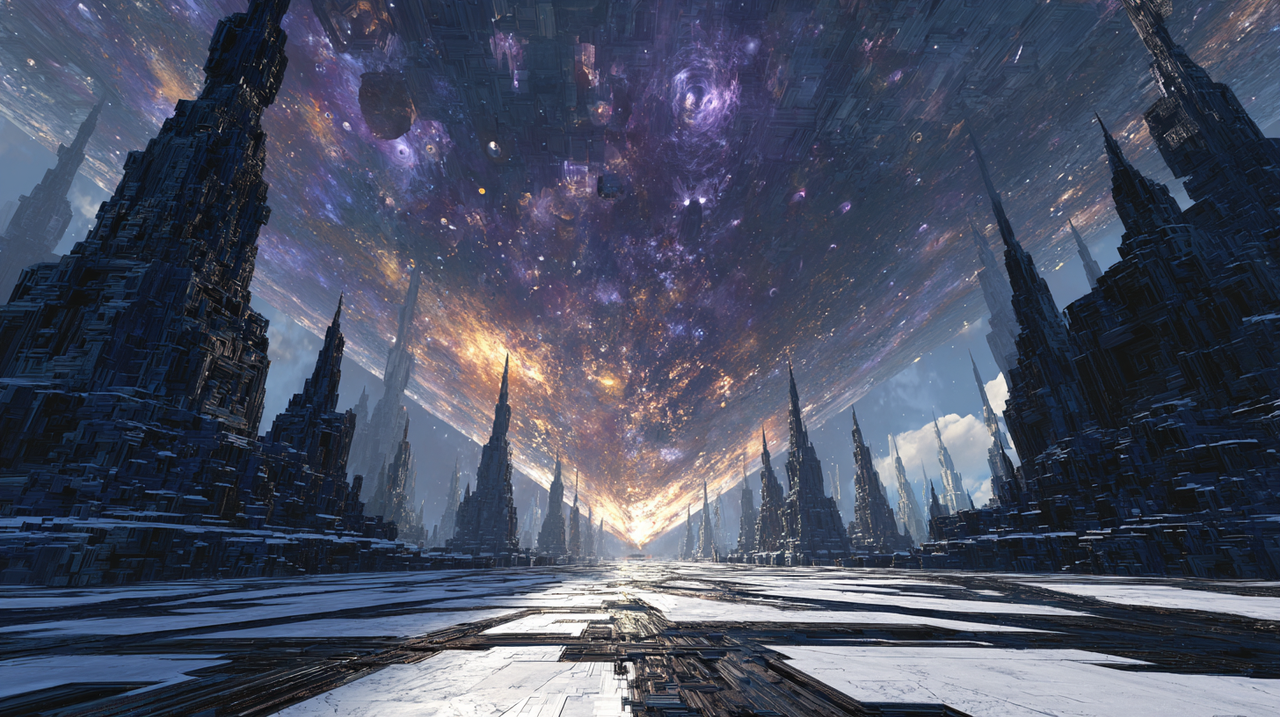
They walked for nearly half an hour, and the sheer, overwhelming scale of the complex only grew. It was a city built by gods or madmen. Causeways as wide as highways connected sprawling plazas, all paved with that same, unsettling black mosaic. Spires of the dark, fractal material rose into the sky, their surfaces a chaotic yet ordered cascade of straight-angled, bismuth-like shapes, as if immense, geometric crystals had been flash-grown to the size of mountains.
The place felt utterly, profoundly dead. The oppressive feeling of being watched that had haunted their last visit was gone. There was only the wind, the silence, and the lingering sense of a power so vast it had simply… moved on. Still, Dmitri felt a nervous tremor in his hands, his mind replaying the horrifying, instantaneous deaths of his team. He half-expected reality to tear open at any moment, to be sliced apart by an unseen blade.
They were crossing a long causeway that led to what looked like a central, kilometer wide plaza when the archaic human stopped. He pointed to a large, indented pattern on the floor ahead—a complex, interlocking design of nested squares. He then turned to a low stele nearby, a squat, folded structure that was almost indistinguishable from the other bizarre formations.
From a pouch at his belt, he removed a set of polished, multi-faceted crystals. He began to place them into small, perfectly cut niches in the stele, his movements slow and ritualistic.
The moment the last crystal clicked into place, the world began to change.
It started with a sound, a deep, sub-audible hum that vibrated up through the soles of Dmitri’s boots. Then came the growing, absolute certainty that something immense and unseen was awakening.
The spires around them began to move.
Entire towers folded and rearranged themselves with an eerie silence. The intricate geometric patterns on the ground shifted, lines of golden light flowing and reconfiguring. Obelisks of the dark, fractal material that had not been there moments before rose silently from the sand, their sharp angles cutting new, stark silhouettes against the rising sun.
Dmitri’s mind, augmented by ARI’s processing power, struggled to make sense of the spectacle. The patterns, the movements—they were not random. They are rotating, ARI’s thought-form communicated, a sense of pure, analytical awe in its logic. This is not a three-dimensional structure. We are standing at the center of a massive hyperdimensional construct. It is rotating through a higher dimension, and we are witnessing its cross-section shift in our spacetime. Everything was spinning around him, with a profound, mathematical order that was both terrifying and beautiful.
Suddenly, a point of light appeared in the center of the plaza, perfectly aligned with the pattern of squares on the ground. A keyhole, somewhere in another dimension, had been aligned.
In the span of a single, silent heartbeat, the point of light bifurcated into a plane that exploded outward. The plane then folded into itself and a shimmering, golden aperture of monstrous proportions tore open, filling the entire kilometer-wide plaza, leaping upwards into the sky like a second, more brilliant sun. On the other side, Dmitri could see… a landscape of intense, golden light, of impossible, shifting colors.
Then he saw the subtile distortions. A massive pressure wave, a wall of force, rushing towards him. He flinched, instinctively raising his arms to shield himself, but the human leader was already moving. He ran towards Dmitri and shoved him hard, forcing him to his knees just as the wave hit.
The pressure didn’t strike him, instead rolling around them, a deafening, reality-bending roar that shook the ground. In an instant, the temperature plummeted. The air, which had been cool, became a blast of intense cold, the temperature dropping to fifty degrees below zero. Every trace of moisture in the atmosphere flash-froze, turning the air into a storm of glittering ice crystals. The black spires turned white, coated in a thick layer of rime.
But Dmitri, the human, and ARI’s drone were unharmed, untouched, standing within a small, invisible pocket of calm. It was as if they were encased in a box of clear, unshatterable glass, watching the violent, unnatural storm rage around them.
It is an aperture connecting this place to another world, ARI analyzed, its logic cutting through the sensory chaos. A world with a significantly denser atmosphere. The violent exchange of atmospheric pressures is causing this effect. The lower pressure of this world is causing the incoming gases to undergo rapid, extreme adiabatic expansion, resulting in the catastrophic temperature drop and the instantaneous deposition of all airborne moisture.
The archaic human rose to his feet. He began to walk towards the shimmering golden gate, and as he did, a cube of the same invisible, protective field formed around him, moving with him. He paused at the stele, removed one of the smaller crystals, and tossed it back to Dmitri. It landed softly in the sand at his feet.
Without another word, without a backward glance, the human walked into the shimmering field of golden light and vanished.
As suddenly as it had begun, the gateway collapsed. The golden light blinking out in an instant, the deafening roar ceased, and the pressure surge dissipated. The world was silent again, but transformed. Everything was coated in a thick layer of brilliant white frost, the sun’s light glinting off a billion tiny ice crystals.
Dmitri stood alone with ARI’s drone in the center of the frozen, alien city, a single, strange crystal in his hand, left to wait for the return of a man who had just stepped into another world.
Support "Amongst the Stars of Cygnus [Hard Sci-fi Survival]"


Log In
Log In